A covered bridge has a way of interrupting a drive. You’re following an ordinary stretch of road when you spot a roof over the creek. Suddenly, you’d like to know a little more. The roof has a practical explanation: it keeps the supporting wooden timbers out of the weather so they last longer. The rest of the story takes a little looking.
Indiana County Parks & Trails documents at least 48 covered bridges in the county’s history. Four are preserved today: Kintersburg, Thomas, Harmon, and Trusal. Kintersburg is temporarily off-site for rehabilitation, so this is a story of three bridges you can see in place and one being prepared to return. Knowing a little about them gives you more to take home.
Pennsylvania has quite a collection.
The Bucks County Covered Bridge Society estimates that Pennsylvania once had at least 1,500 covered bridges. Visit PA puts the number remaining at nearly 200, more than in any other state. We have four of them here in Indiana County. That puts a small local drive within a much bigger story.
The Federal Highway Administration’s Covered Bridge Manual cites a conservative estimate of at least 10,000 covered timber bridges built in the United States before 1900. Wood was a practical building material, and covering it helped protect the investment. As traffic grew heavier and wider, iron, steel, and concrete bridges increasingly took their place. The ones left give us a chance to see how an earlier road network functioned.
Get to know the four.
Kintersburg Bridge was built over Crooked Creek by J. S. Fleming in September 1877 for $893. Its name connects it to Isaac Kinter and his father, Revolutionary War veteran John Kinter. The county’s covered-bridge brochure identifies it as the only Howe truss bridge among the four; Thomas, Harmon, and Trusal use Town lattice trusses. A truss is the framework that helps carry the bridge’s weight. A Howe truss combines diagonal wooden braces with vertical metal rods. A Town lattice truss uses crisscrossing wooden members, creating a pattern of diamonds.
Before Thomas Bridge, this was a ford. Getting across meant going through the creek. When the county approved a bridge near John and Amos Thomas’s property in June 1877, it agreed to pay two-thirds of the cost. John Thomas paid the rest.
The county brochure dates Amos Thomas’s original bridge to 1879 and puts its cost at $545. It was completely reconstructed in 1998 for slightly more than $1 million. Both figures are in the dollars of their respective years, without adjustment for inflation. The crossing has a long history, and a newer chapter in the woodwork.
Harmon is the youngest of the four. Designed by County Engineer Thomas Pealer and built by John R. Carnahan, it was completed in July 1910 for $525. About half a mile downstream sits Trusal, also known as Dice’s Bridge. It’s the oldest of the four and, at 41 feet, the shortest. Trusal was bypassed in 1990. The road moved on, but the bridge stayed.
Make a drive of it.
Indiana County Parks & Trails has an official driving tour that starts in downtown Indiana and connects the four bridge sites. For now, plan to see Thomas, Harmon, and Trusal in place. Kintersburg has been temporarily removed for rehabilitation, with plans to return it to its original crossing. Check with the county before making that stop; a reopening date has not been confirmed for this article.
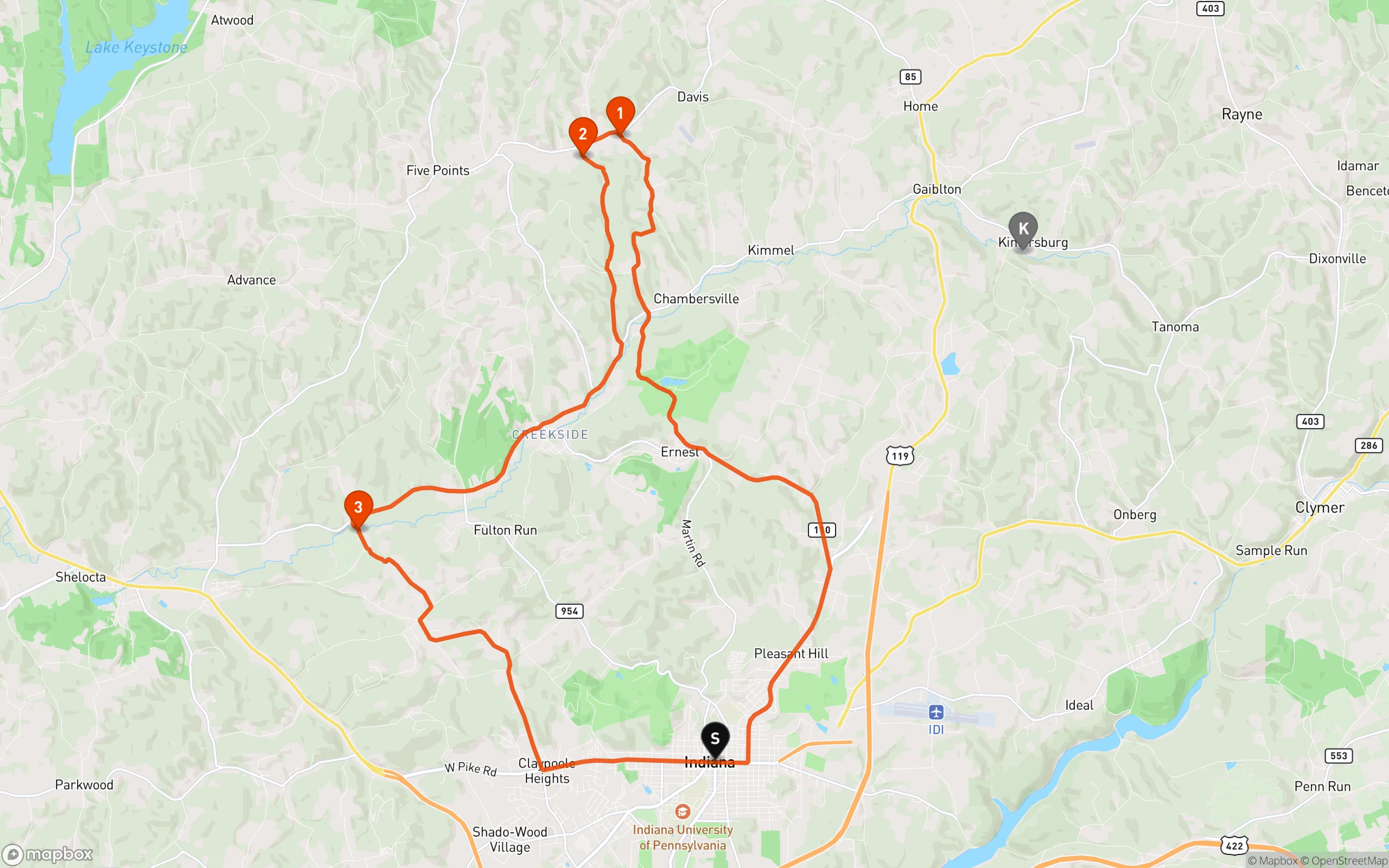
Harmon + Trusal detail
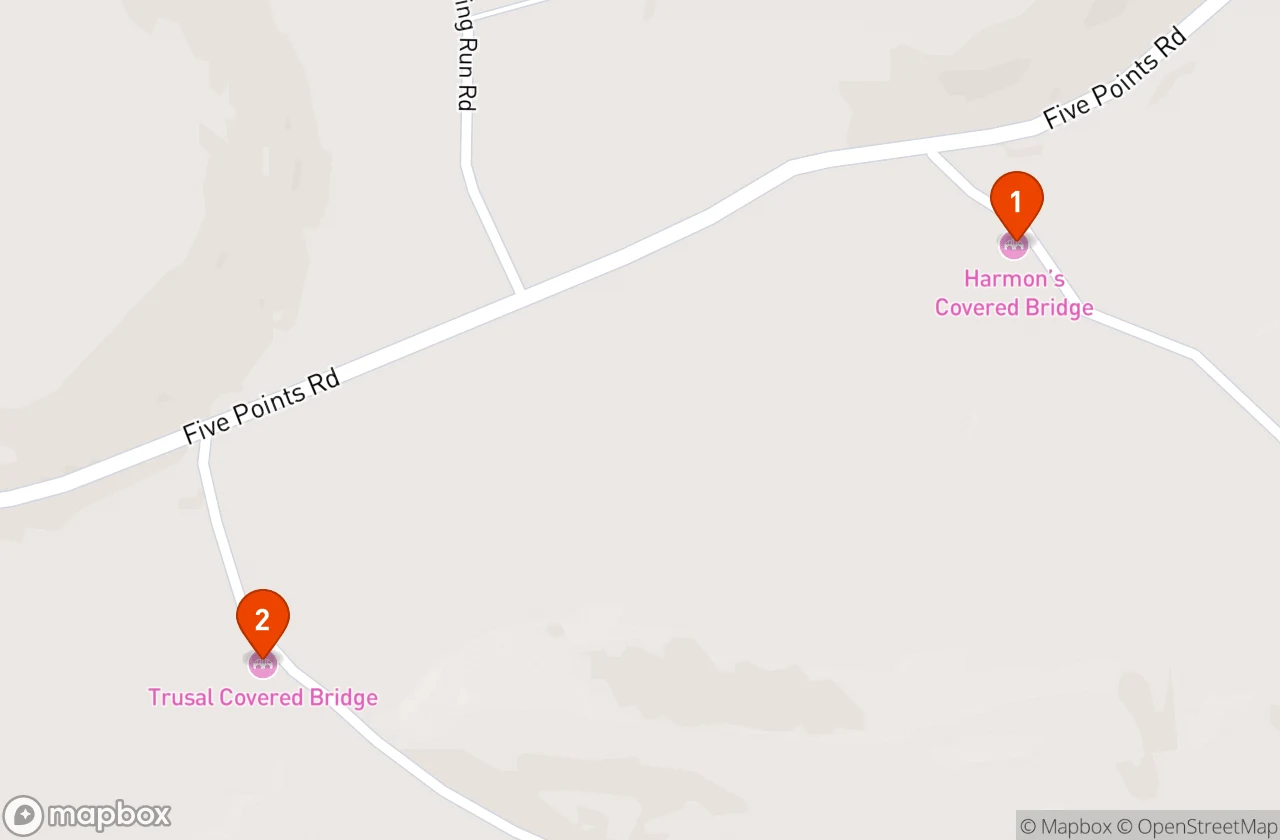
The Three-Bridge Loop (Starting and Ending in Downtown Indiana)
- Approx. distance
- 25 miles
- Driving time
- 57 minutes + stops
- 00Kintersburg(Temporarily Off-Site)Apple Maps · Google Maps
- 01HarmonApple Maps · Google Maps
- 02TrusalApple Maps · Google Maps
- 03ThomasApple Maps · Google Maps
Check the county’s visitor information and the weather before you head out. At the bridges, follow posted signs, leave room for other traffic, and respect neighboring property.
A reason to take the long way.
There is something worth stopping for in a covered bridge. The shape is familiar, but each setting gives it a different character: the width of the creek, the curve of the approach, the trees around it. These are the details that give each stop a character of its own.
The history explains who built the bridges and what they cost. Being there offers another way to appreciate them. A crossing that once helped someone get where they were going can now be the reason for the trip.
Two cents to get across.
Blairsville once had a 300-foot covered toll bridge. Walking across cost two cents, or you could buy a yearly pass for $1.50. Schoolchildren and funerals crossed free. The county’s history of the Blairsville bridge records wagons and stagecoaches among the traffic, along with cattle, sheep, and swine. Those small details make it easier to imagine the crossing on an ordinary day, with people going about their business.
That bridge eventually collapsed. The county’s map of historic covered-bridge locations shows how many more there were beyond the four preserved today. If the drive leaves you curious, the county also recommends Country Crossing… Indiana County’s Covered Bridges, published by the local historical society. It covers all documented county bridges, including the ones you’ll have to meet on the page.
One bridge is taking a trip of its own.
Kintersburg is temporarily away from Crooked Creek. Gibson-Thomas Engineering reports that crews lifted its historic Howe trusses from their supports for off-site rehabilitation at Lancaster County Timber Frames’ facility in York County. The plan is to reassemble the bridge at its original location. Keeping an old bridge sometimes means taking it apart.
County commissioners approved Horizon Construction Group’s $807,314 rehabilitation bid in 2025. That is the construction bid, rather than the full cost of every part of the project. It gives a sense of the commitment behind bringing the bridge home.
Indiana County Parks & Trails took over management of the four covered bridges in 2007. The empty crossing is part of their story, too. These bridges have lasted because people keep deciding they’re worth the work.
You don’t have to know a truss from an abutment to enjoy the visit. Start with a bridge that catches your eye. There’s more of Indiana County on either side of it.
Sources & further reading
- National Society for the Preservation of Covered Bridges: Covered Bridge Trivia
- Indiana County Parks & Trails: History of our Covered Bridges
- Indiana County Parks & Trails: Covered Bridges
- Bucks County Covered Bridge Society: History of Covered Bridges
- Visit PA: Covered Bridges
- Federal Highway Administration: Covered Bridge Manual
- Iowa State University, Institute for Transportation: Preserving America’s historical covered bridges
- Indiana County Parks & Trails: Indiana County Covered Bridge Driving Tour
- Indiana County Parks & Trails: Blairsville’s Covered Bridge
- Indiana County Parks & Trails: Historic Covered Bridges map
- Indiana County Parks & Trails: Covered Bridges of Indiana County brochure
- Gibson-Thomas Engineering: Kintersburg rehabilitation update
- Indiana County Commissioners: Rehabilitation bid approval, August 2025